
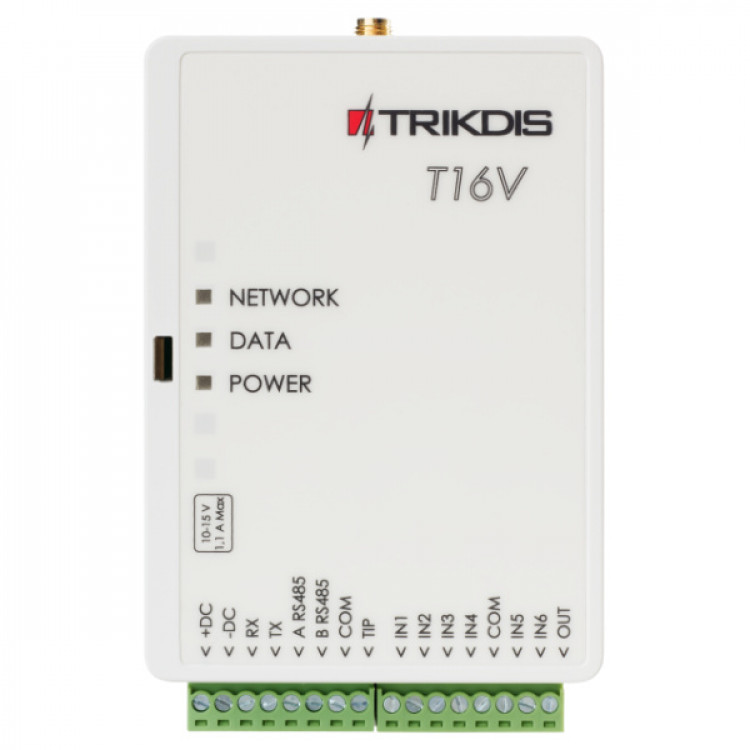
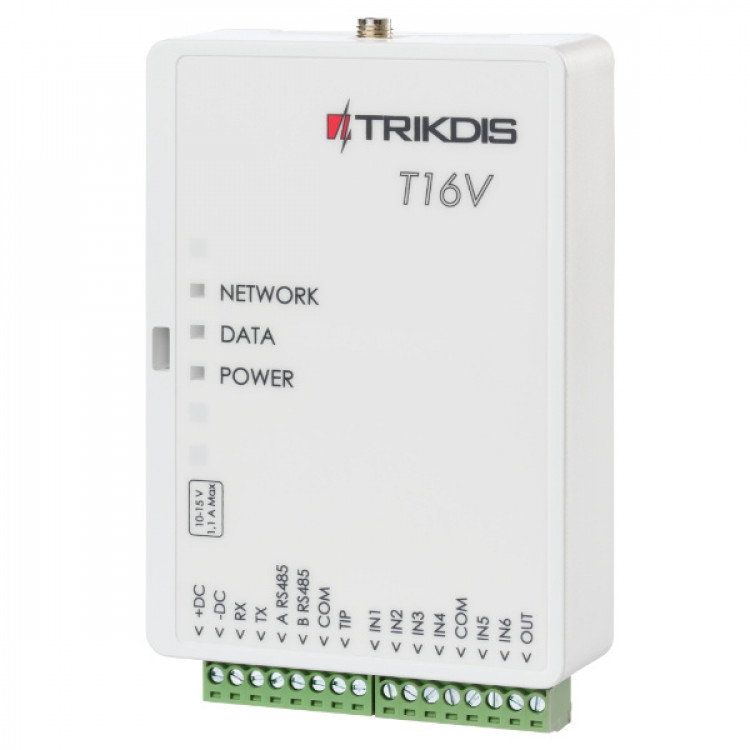
Trikdis T16V VHF radio communicator
- Brand: Trikdis
- Product Code: T16V
- Availability: Ordered upon request
- Warranty: 2 years
- Categories: Radio Communicator

-
€117.77 Ex Tax: €95.75
Available Options
The T16V VHF radio communicator is compatible with Paradox, DSC, Pyronix, UTC Interlogix (Caddx), Innerrange, Honeywell, Texecom and Crow alarm control panels via DATA BUS or SERIAL PORT, and with other manufacturers' alarm systems via TIP RING connection. It transmits its own and the alarm control panel's events to the monitoring station via VHF radio, and also supports Trikdis Ethernet / WiFi IP modules for IP-based primary communication.
Key features:
- Compatible with popular alarm control panels from major manufacturers via data bus or serial port
- Unsupported panels can be connected via TIP RING (Contact ID and 4+2 format)
- Events transmitted to monitoring station on VHF frequency
- RAS3, RAS2M, LARS1, LARS radio network protocol
- Output power from 1 W to 5 W
- Events forwarded to monitoring station in Contact ID 4+2 format
- Use of alarm panel identifier
- Fast and easy installation and configuration via USB
- 2 access levels for configuration and control: Administrator, Installer
- RS485 port compatible with Trikdis Ethernet / WiFi IP modules for primary channel
- 6 contact inputs for additional zones, configurable type: NC, NO, EOL (2.2 kΩ)
- 1 output for remote control, e.g. arming / disarming or gate control
Connection to data bus (or serial port) – what does this mean?
In this case, the connected device is essentially taught to read the alarm panel's own language. Just like keypads or other peripherals, the communicator sees the events and will forward the relevant information according to the settings.
Read our article for more details.
TIP!
If you are connecting this device to a Paradox or Secolink panel, we also recommend the CRP2 serial port cable.
Related Products

Tags:
Frequently asked questions
Protegus 2 is the 2nd generation of Trikdis's cloud app: control your alarm system from your phone and get instant notifications. We recommend it for every current internet-connected Trikdis device. The user app is free; the paid, usage- (customer-) based tier is for monitoring stations, installers and companies.
The radio communicator (T16U UHF / T16V VHF) signals on its own radio frequency to a dedicated receiver station — ideal where there's no reliable mobile network or internet. GSM/IP communicators signal over the mobile network or internet to a monitoring station or to Protegus.
Yes, using the TrikdisConfig programming software (via USB or remotely). The latest firmware is recommended for the best compatibility and security.
Yes: Protegus 2 can be tried on a live demo system, without installation or purchase — from a browser and from the mobile app too. This lets you see in advance what arming, notifications, and system status look like on a working alarm system.
Protegus 2 typically retains the event list for up to two months; with a large volume of events, this period may shorten to as little as one month.
The AUX power output of the Paradox SP4000 alarm panel has limited load capacity. In certain cases — whether using a dedicated or a universal TRIKDIS communicator — the communicator's current draw can place too much load on the AUX output. As a result, the communicator may become unstable, restart, or fail to operate correctly.
Experience shows that the problem is usually solved by powering the TRIKDIS communicator directly from the alarm panel's battery terminals (+/-) instead of from the AUX output. This provides a stable power supply and eliminates the restart or operational issues.
Note: Before changing the wiring, always check that the system complies with the manufacturer's specifications and that the total load on the power supply does not exceed the permitted value.