
One application for all Trikdis devices



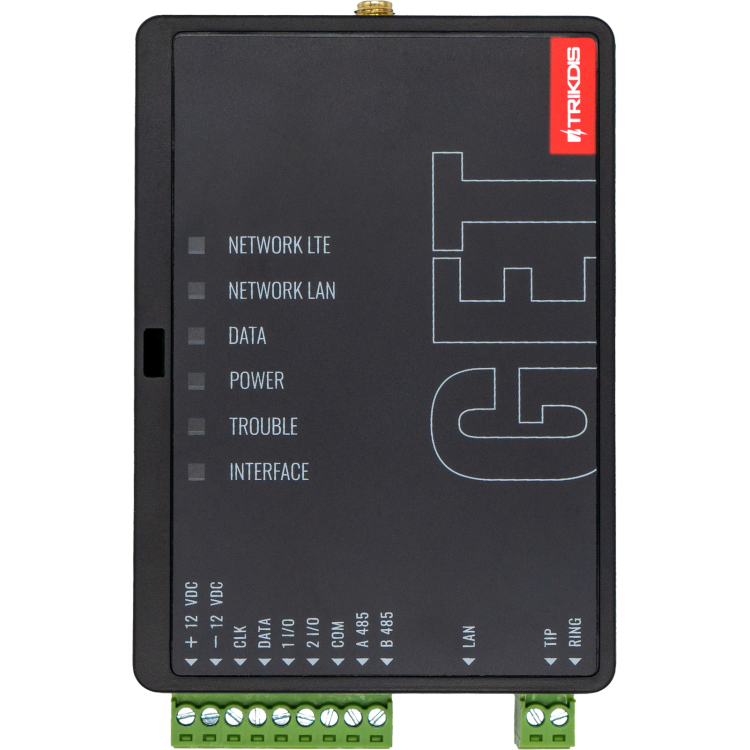
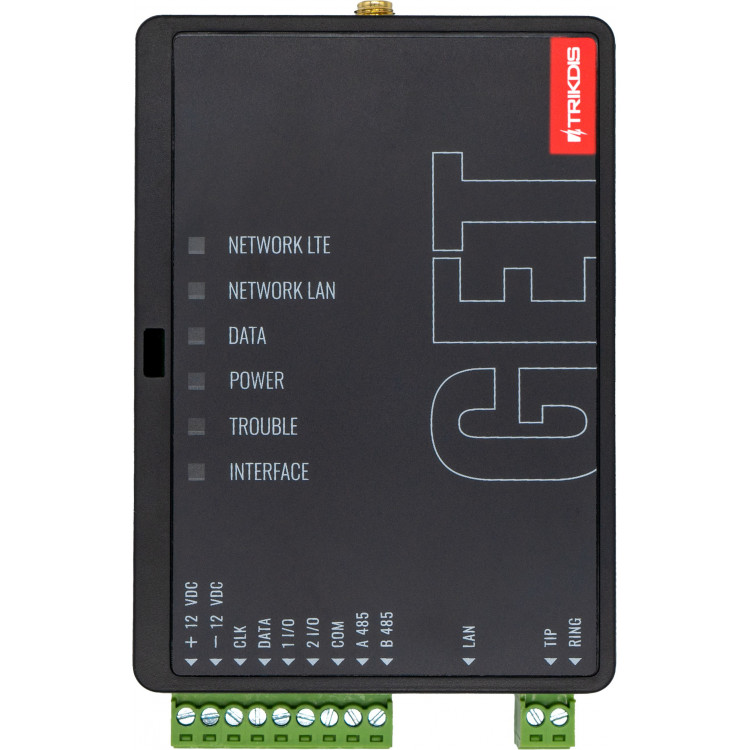
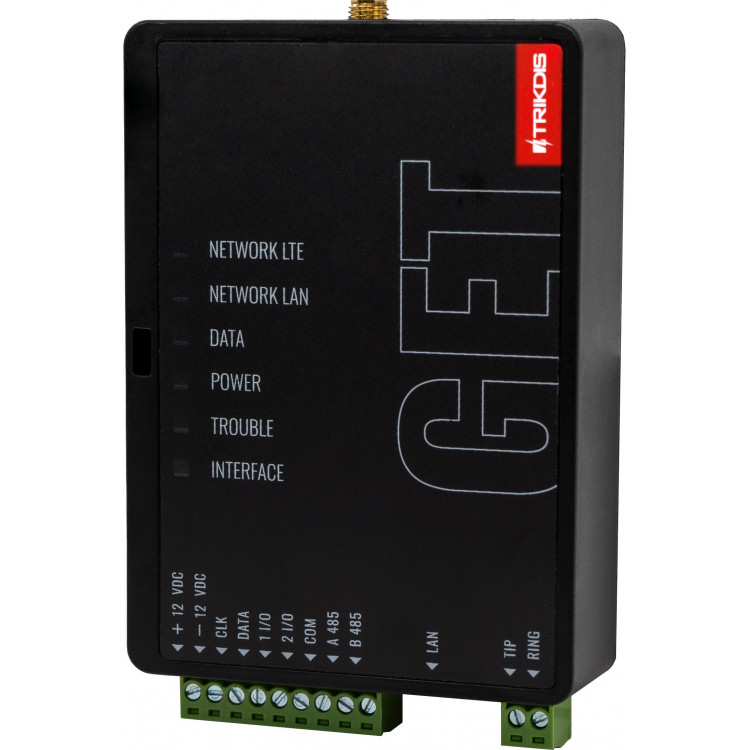
Trikdis GET Ethernet + 4G smart communicator
- Manufacturer: Trikdis
- Item code: GET
- Availability: In Stock
- Warranty: 2 years
- Categories: Alarm Communicator > Ethernet Communicator > GSM Alarm Communicator > Dual-path Redundant Communicator

-
€229.90 Ex Tax: €186.91
GET Communicator + Paradox SP7000+ | Full Setup & User Code Configuration Guide
This video demonstrates how to connect and configure the Trikdis GET communicator with an already installed Paradox SP7000+ control panel via KeyBus and TIP/RING. The step-by-step guide covers system creation, user code management, and arming test using the mobile application.
GET & Protegus 2 | Faster Alarm System Setup for Installers
GET communicator and the Protegus 2 app together reduce alarm system installation time: setup begins with a QR code scan, default parameters load automatically, and the installer only enters the values required by the monitoring station.
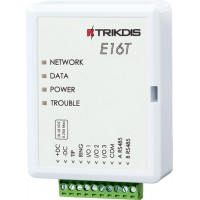
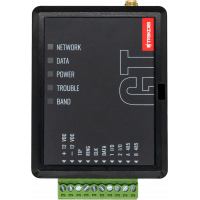
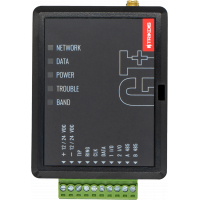
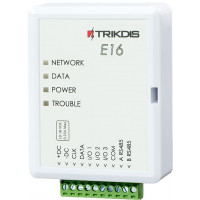
The Trikdis GET Ethernet + 4G smart communicator is the top-tier device from the manufacturer, combining the capabilities of the E16, E16T, G16, and G16T communicators.
From the "E" series, it inherits Ethernet functionality, and from the "G" series, it features "GSM" 4G mobile network connectivity. It can be directly connected to alarm systems from manufacturers like Paradox, DSC, and others using the data bus (DATA BUS) or serial port (SERIAL PORT) connection. For unsupported alarm control panels, just like the communicators with the "T" suffix, GET allows the traditional landline (TIP RING) connection.
It transmits data to the central monitoring station and the user via wired internet connection (LAN) and/or 4G mobile network. The two connection options can be used redundantly, ensuring that if the primary connection (typically ethernet) is lost, it immediately switches to the backup connection.
Like all smart Trikdis devices, the user application here is Protegus 2 Mobile and Web app. The alarm system, through the communicator, allows the owner to remotely arm or disarm it from the mobile app and control or monitor additional connected devices.
Alarm control panels connectable via data bus or serial port
Die Trikdis E16, G16, GT, GT+, GET are compatible with all the alarm control panels listed below . The main advantage of these specialized Trikdis communicators is that events are transmitted via the data bus or serial port.

Magellan MG5000, MG5050, MG5050+*
DIGIPLEX EVO48, NE96, EVO96, EVO192*, EVOHD* (*Fw. above 7.50)
For direct control, the firmware of PARADOX panels must be at least version V.4.
* Die serial port on the new marked alarm panels is locked at the factory. The port must be enabled before communication with an external device is possible.



Premier Elite 12, 24, 48, 64, 88, 168

Magellan MG5050E
ESPRIT E55, 728ULT, 738ULT



Do Trikdis special communicators support the DSC Power Series NEO product family?
NO! Use the universal communicators E16T, G16T, GT, GT+, GET with telephone line (TIP RING) connection!
Read the details: DSC Power Series NEO and Trikdis Communicators: Compatibility and Solutions
Main features
- Redundant Cellular and IP-based communicator
- Compatible with popular security control panels on data bus or serial port from major manufacturers and any others with landline (TIP RING) terminal
- When Protegus 2 service is enabled, events are first delivered to CMS, and only then are sent to app users (or option to parallel report).
Notifies users
- Users are notified about events and can control the system via the free Protegus 2 Android / iPhone and web app
- “Push” and special sound notifications informing about events.
- Remote system Arm/Disarm.
Controllable outputs
- 2 double I/O terminals that can be set either as input (IN) or controllable output (OUT) terminals.
- Outputs controlled by the Protegus 2 app.
- Add additional inputs and controllable outputs up to 32 total with iO8 expander via the RS485 port
- Remote control of connected devices (lights, gates, ventilation systems, heating, sprinklers, etc.).
Quick setup
- Settings can be saved to file and quickly written to other communicators.
- Two access levels for configuring the device for CMS administrator and for the installer.
- Quick and easy configuration and firmware updates via USB or remotely after initial setup with Trikdis programming software.
- USB C for programming (replacing the USB mini which was used before)
- Remote configuration and firmware updates.
Central monitoring station
- Sends events to Trikdis software or hardware receivers that work with any monitoring software.
- Can send event messages to universal SIA DC-09 and SUR-GUARD TL150 receivers
- The module transmits the messages of the control panel to the monitoring station in Contact ID code format
- Connection supervision by polling to IP receiver every 30 seconds (or by user-defined period).
- Backup channel, that will be used if connection with the primary channel is lost.
- With parallel communication channels events can be sent to two receivers at the same time.
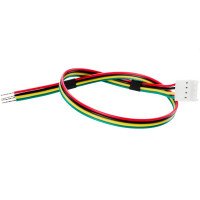
You'll Need a Cable for Connection
Connection to Data Bus or Serial Port, What Does This Mean?
In this case, the communicator is practically taught to understand the alarm panel's own language (one-way communication). Just like operators or other peripheral devices, the communicator sees events and will transmit the appropriate information according to the settings.
Direct Control
In the case of directly controllable panels, the communicator not only receives notifications from the panel but also a part of the functions available on the keypad becomes accessible (bidirectional communication).
- Activation / deactivation of the entire system or partition using a user code
- Detection of zone statuses
- Zone bypass
- Automatic mapping of partitions and zones
Communication
4G IP communication
To Protegus cloud, to iOS/Android Protegus mobile apps
LAN
Compatible devices
Contacts (inputs and outputs)
Programming
Users
Technical data
Related Products

Related Articles
Alarm Control Panel Direct Control via Data Bus or Serial Port
- 19/10/2018
Trikdis direct control via data bus or serial port: advantages, compatibility and available functions.
Read More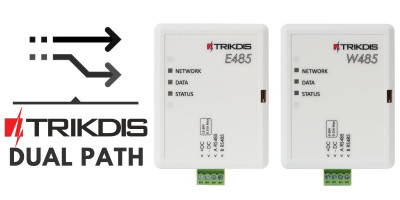
Dual Path – Redundant Channel Solutions from Trikdis
- 01/12/2019
Trikdis W485/E485 modules: redundant communication channel alongside GSM communicators, with lower data costs.
Read More
New Supported Protocol for Trikdis Communicators – Sur-Gard TL-150
- 08/02/2020
Trikdis communicators now support Sur-Gard TL-150 protocol – no IPcom virtual receiver required.
Read More
4G/LTE Frequency Bands Used in Europe
- 05/07/2022
A complete list of 4G/LTE frequency bands used in Europe – useful for selecting the right Trikdis GSM communicator.
Read More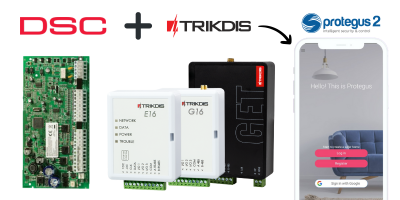
TRIKDIS Communicator + DSC Alarm Control Panel – Brief Installation Guide
- 19/01/2024
Brief installation guide for connecting a DSC alarm control panel with a TRIKDIS communicator and setting up the Protegus 2 application.
Read More
DSC Power Series NEO and Trikdis Communicators: Compatibility and Solutions
- 01/03/2025
Are DSC Power Series NEO systems compatible with Trikdis special communicators? Solutions and alternatives.
Read More
Comparison Table of TRIKDIS Communicators for Alarm Systems
- 01/04/2025
Overview of TRIKDIS alarm communicators by connection type and communication method. Find the right model for your alarm system.
Read MoreTags
Frequently asked questions
Traditionally via telephone line (TIP/RING) — a universal solution that lets devices communicate regardless of brand. Trikdis's own development means that panels on the supported list (and only those) can also be connected directly and digitally via serial port or data cable — as far as we know, no one else offers this, backed by 10-15 years of development.
Protegus 2 is the 2nd generation of Trikdis's cloud app: control your alarm system from your phone and get instant notifications. We recommend it for every current internet-connected Trikdis device. The user app is free; the paid, usage- (customer-) based tier is for monitoring stations, installers and companies.
Check the product page of any direct-connection communicator — e.g. E16, G16, GT, GT+, GET: if your panel's model is on the supported list, we strongly recommend that one. In every other case, choose the telephone-line (TIP/RING) version. Pick the communication type (4G / Ethernet) based on what's available on site.
Two parallel communication channels (e.g. Ethernet + 4G): if one drops, the other automatically takes over signalling. This gives the highest reliability, which standards may even require (a higher Grade rating). The GET and FLEXi SP3 work this way. An add-on module also exists for existing communicators, in WiFi (W485) and Ethernet (E485) versions.
Yes, using the TrikdisConfig programming software (via USB or remotely). The latest firmware is recommended for the best compatibility and security.
Yes: Protegus 2 can be tried on a live demo system, without installation or purchase — from a browser and from the mobile app too. This lets you see in advance what arming, notifications, and system status look like on a working alarm system.
There is no standalone Trikdis communicator that communicates exclusively over Wi-Fi, but the SIM-card communicators can be extended with the W485 Wi-Fi expansion module. There is also a purely Wi-Fi version, as well as a Wi-Fi + SIM 4G version, of the FLEXi SP3 alarm panel.
Protegus 2 typically retains the event list for up to two months; with a large volume of events, this period may shorten to as little as one month.
The AUX power output of the Paradox SP4000 alarm panel has limited load capacity. In certain cases — whether using a dedicated or a universal TRIKDIS communicator — the communicator's current draw can place too much load on the AUX output. As a result, the communicator may become unstable, restart, or fail to operate correctly.
Experience shows that the problem is usually solved by powering the TRIKDIS communicator directly from the alarm panel's battery terminals (+/-) instead of from the AUX output. This provides a stable power supply and eliminates the restart or operational issues.
Note: Before changing the wiring, always check that the system complies with the manufacturer's specifications and that the total load on the power supply does not exceed the permitted value.
The Trikdis communicator reads the codes from the panel at start-up, so it only knows the codes that existed at that moment. If codes are changed in the Paradox panel, the Trikdis device must be restarted — for example by disconnecting and reconnecting its terminal block.
After restarting, the device reads the current codes and the new code works in the app as well.
Not for Paradox devices: Paradox's own tools, e.g. Babyware, IP150, IP180, work with a locked serial port as well. Unlocking the serial port is only needed when connecting a third-party device — such as a Trikdis communicator.
Yes. On the DSC data bus the Trikdis device plays a mostly passive, listening role. If many other devices communicate on the bus — typically keypads and expander modules — the Trikdis device may not “get a word in”: it may fail to read system data and may be unable to send control commands (such as partition arming).
The issue does not occur in every installation, but above 3–4 keypads or expander modules the likelihood increases — worth considering during the site survey.
For such cases we recommend the universal version that connects to the phone-line (TIP/RING) input: the E16T or the G16T. On the GT, GT+ and GET the connection mode can be switched inside the device, so where possible we recommend these for such installations.
For decades, alarm panels reported events to the monitoring station over the fixed telephone network: the telephone dialler built into the panel “made calls” in a standard format — typically Contact ID (CID). It became such a universal standard that the TIP/RING connection is still present in almost every panel from every manufacturer, including the newest ones.
The fixed telephone line is disappearing, but the connector has found a new life: a modern communicator (such as the Trikdis E16T or G16T), wired to the TIP/RING terminals, “presents” a telephone line to the panel — providing line voltage and a dial tone. The panel believes it is calling the monitoring station; in reality the communicator answers the call, decodes the Contact ID message and forwards the event over the internet or the mobile network to the monitoring station and the Protegus 2 app.
The great advantage of this solution is brand independence: it works with practically any panel — even decades old — that has a telephone dialler, with no direct bus or serial integration. That is why we call this type of device a universal communicator.
Take the card out, put it in a phone, turn off every other internet source and open an article on a news site. If it loads, the card has working data — then note the APN and switch the PIN request off.
A regularly recurring problem: during installation you want to create the system in Protegus 2, but you get the message that the device is offline. In that case it is best to rule out the SIM card and the data connection first — it takes a few minutes with a phone.
Checking the SIM card with a phone
- Remove the SIM card from the device and insert it into a phone.
- Turn off every other source of internet connection so that the SIM card in question can be tested undisturbed: Wi-Fi, on a dual-SIM phone the other SIM card as well, or anything else — this way the traffic certainly goes through the card being examined.
- Turn on mobile data.
- Open a website in the browser, for example a news site, and open an article inside it too. If the article loads as well, the data connection on the card works. (A home page you opened earlier may come from the phone's cache — that is why an article must also be opened.)
If there is no internet connection, find out why: an incorrect or missing APN setting, no subscription on the card, an exhausted or expired data allowance, etc. Once that is sorted out and the connection really works, continue with step 5. - In the phone's settings check which APN belongs to this SIM card and write it down.
- Recommendation: turn off the PIN code request on the SIM card. A PIN code can of course be used and it does add security, but in devices like these we generally do not recommend it, and it is not needed for operation.
Back into the device
- Take the SIM card out of the phone and put it back into the Trikdis device.
- Using TrikdisConfig, enter the device's programming and set the APN you wrote down in the APN setting.
- Write the changes to the device, then check whether the data connection is restored — that is, whether the device is online in Protegus 2.
If it works in the phone but not in the device
The problem is almost certainly the PIN code or the APN. If the device sees the network but no connection to the server is established, check the APN first — an empty or mistyped APN is the typical symptom.
If the device picks up several networks and switches between them, it is worth setting a preferred operator. See: Setting a preferred operator – MCC and MNC codes (Europe).